Показаны сообщения с ярлыком JOTA. Показать все сообщения

четверг, 5 июня 2014 г.

How to connect to ScoutLink

IRC

There are different ways you can connect to ScoutLink. If you already have an IRC-Client or you want to install one then just enter the data provided, and connect. If you do not know how to install an IRC-Client or how to enter the data just look at our configure mIRC page.
If you think that all is to complicated then just start with one of our webchats.
Here is the info you need for your IRC-Client
Networkname: ScoutLink
Port: 6667
Server: chat.scoutlink.net
Here is an example how it could look on mIRC.
There are a lot of servers, please choose one near to your location. The following list shows you the names of servers near to you. Using one of them always connects you to a server in your region. If you do not know what to choose just take chat.scoutlink.net. Port is always 6667

chat.scoutlink.netConnects you to a random server
chat.eu.scoutlink.netUse this if you are somewhere in Europe
chat.nl.scoutlink.netUse this if you are from The Netherlands
chat.de.scoutlink.netUse this if you are from Germany
We also offer IPv6 enabled Servers, please use chat.ipv6.scoutlink.net to connect to them.

Secure IRC (IRC-SSL)

All of our servers have SSL enabled. Using SSL encrypts your connection to the server, so that no one between you and the server could read the data you are sending. Our port for secure IRC is 6697.  All Servers support ssl.
You have to tell your client that it trusts the SSL certificate, you also have to tell the client that it should use SSL. See the "configure client" section for more details. For mIRC you have to enter the port as "+6697".

TeamSpeak

ScoutLink is more than just text based chatting via IRC. We also offer a TeamSpeak Server and we hope to include other services in the future.
Information on how to setup your TeamSpeak client, so that you can talk to others, can be found at our TeamSpeak page.

суббота, 5 апреля 2014 г.

Nos dias 19 e 20 de outubro de 2013, em todo o mundo, grupos escoteiros participaram das atividades do Jamboore do Ar ( JOTA e JOTI ), onde puderam realizar atividades diversas e trocarem experiências, seja pelas ondas de rádio ou pela internet.
VLUU L100, M100  / Samsung L100, M100O MG 148º G.E. Papa Léguas esteve participando ativamente de ambas atividades, sendo que a Base do JOTI foi montada na sede do grupo, onde os Escotistas: Aline, Rafael Raymundo, Pioneiro André, Guia Lívia e Escoteiro Kevin, estiveram por mais de 36 horas conectados e cumpriram maioria das atividades propostas…
Base do JOTI - Sede do G.E. Papa Léguas
Base do JOTI – Sede do G.E. Papa Léguas
A Base do JOTA, coordenada pelo Dirigente Walter, foi montada na Serra do Paredão, com uma estação de rádio amador, onde a tropa de escoteiros puderam ouvir e comunicações de grupos escoteiros de diversas partes do pais.
Base do JOTA - Serra do Paredão
Base do JOTA – Serra do Paredão
Também, para dar um clima de aventura, os Escoteiros realizaram uma jornada até o local onde estava localizada a base do JOTA. Lá, sob a coordenação dos escotistas: Adriano, Manoel, Rômulo, Ribeiro, Walter,  Lucelia e Ana Francisca, os jovens puderam participar de algumas das atividades proposta pelo programa do JOTA.
Jornada até a Serra do Paredão ( 06 km )
Patrulha Escoteira em atividade
A manhã do dia 20, após uma trilha na madrugada, os jovens se reuniram no “Pico do Lobo”, onde foi realizada uma reflexão matinal, apreciando o nascer do sol…  Em seguida, retornaram para casa…
Trilha na serra durante a madrugada
Reflexão matinal...
Reflexão matinal…
VLUU L100, M100  / Samsung L100, M100

пятница, 4 апреля 2014 г.

 Three Reasons Why You Should Participate in JOTA
 5 October 2012 | by Enoch KE5HWQ  |   |   |  Leave a Comment (3)


Hello! My name is Enoch Heise and I am a 17-year-old Life Scout and General Class Amateur Radio Operator (KE5HWQ). I’m also working on installing a repeater for my Eagle Project.

I would like to tell you about the Jamboree on the Air, an exciting annual event which crosses over both Scouting and Amateur Radio, and give you 3 reasons why you should definitely plan on participating this October.

What is JOTA?

From arrl.org:

“When Scouts want to meet young people from another country, they usually think of attending a World Jamboree. But few people realize that each year more than 400,000 Scouts and Guides “get together” over the airwaves for the annual Jamboree-on-the-Air (JOTA). Modern technology offers Scouts the exciting opportunity to make friends in other countries without leaving home.

JOTA is an annual event in which Boy and Girl Scouts and Guides from all over the world speak to each other by means of Amateur (ham) Radio. Scouting experiences are exchanged and ideas are shared via radio waves. Since 1958 when the first Jamboree-on-the-Air was held, millions of Scouts have met each other through this event. Many contacts made during JOTA have resulted in pen pals and links between Scout troops that have lasted many years.

With no restrictions on age or on the number of participants, and at little or no expense, JOTA allows Scouts to contact each other by ham radio. The radio stations are operated by licensed amateur radio operators. Many Scouts and leaders hold licenses and have their own stations, but the majority participate in JOTA through stations operated by local radio clubs and individual radio amateurs. Some operators use television or computer-linked communications.

JOTA is held the third weekend in October of each year. JOTA takes place starting Saturday at 0000 hours local time (12:00 AM) to Sunday, 23.59 hours local time (12:00 PM), though some activity continues over from Friday to Monday to take advantage of long distance (DX) time differences.”

I have participated in JOTA for three years now, and these events comprise some of my fondest memories from my Scouting experience, and this year I will be volunteering for the JOTA event at the National Scouting Museum in Irving, TX.

So, if you’re not already convinced to participate in JOTA, here are 3 good reasons why this is an event that you can’t pass up:

Reason #1: The opportunity to make an impact in some young mens’ lives

Before the days of the Internet, Radio was one of the biggest, quickest, most cutting edge methods of communication; and, coincidentally, Ham Radio was born at about the same time as Scouting. Naturally, early Scouts found Ham Radio to be a very effective way to exercise the Scout Motto: Be Prepared! And it still is today.

Many Scouts throughout Scouting’s history have been licensed Ham Radio Operators, and any Scout today can become one. Today, the two main ways Radio has been officially implemented into Scouting are through the Jamboree on the Air and through the B.S.A.’s Radio Merit Badge.

Yet, sadly, many Scouts today haven’t heard about Amateur Radio. JOTA is a great way to get the word out and introduce many new Scouts to the value and excitement of Amateur Radio. Your involvement in JOTA can help Scouts discover this fantastic hobby and community service.

Reason #2: Community

Perhaps you’re already involved in the local Ham Radio and Scouting Communities. But whether you are or not, JOTA is a great way to get to meet new people in both Scouting and Ham Radio. The deeper I have gotten into both Scouting and Amateur Radio, the more I have come to realize that they share a lot of similarities beneath the surface.

Many Adult Scout Leaders and Ham Radio Operators share similar values and have similar interests. JOTA is one of the biggest events where these two communities overlap, and it is an excellent opportunity to make new connections and friendships with other like-minded people in your community.

These days, most communities are very spread out and poorly connected. This has several disadvantages, especially in the event of a local disaster, something both Scouting and Ham Radio are dedicated to prepare for. JOTA can bring the community closer together and make it better prepared to face anything that comes its way.

Reason #3: The Joy of Ham Radio

JOTA is a great opportunity to get out and operate on many different modes and bands. At the National Scouting Museum in Irving, TX, they will have the following stations set up:

HF Voice Station
HF PSK31 Station
VHF local and Echolink
UHF IRLP
Hidden transmitter hunts
Solar telescopes and Space weather
AMSAT Satellite demos
NTS message origination
Morse Code education (Promote Morse Interpreter Strip award)
ARISS contact setup and execution
Even if you are an experienced Amateur Radio operator you may not have gotten to try out all of these activities. With a a little preparation, your local club or group can put together a JOTA experience that is fun for not only the Scouts, but for every Ham!

JOTA gives you the chance to be involved in some young men’s lives; it gives you a chance to connect with your community; and it just a super-fun activity to take part in!

If you don’t have any plans for JOTA this year, now is the time to make some! All-in-all, Jamboree-on-the-Air is a wonderful event that has much to offer to Scouts, Scout Leaders, and Ham Radio enthusiasts of all ages!

Enoch Heise, KE5HWQ, is a special contributor to AmateurRadio.com. Contact him at scoutingforlife@hotmail.com.

ICOM JOTA Support

We’re delighted to see ICOM America’s support of Jamboree on the Air. JOTA is the world’s largest Scouting event with nearly 700,000 Scouts participating from 6,000 amateur radio stations in 150 countries. It all happens the third weekend of October. This year marked the 56th anniversary and it happened on October 20-21.
As part of ICOM America’s sponsorship of Boy Scouts of America’s amateur radio programs, they’ve agreed to provide promotional support of Jamboree on the Air. This is in addition to their amateur radio station loan program to local Scout councils and their transceivers and repeater sponsorship at the 2013 National Scout Jamboree at the Summit in West Virginia.
You can learn more about Jamboree on the Air at the official BSA JOTA web pages. Detailed operator guidelines, including recommended frequencies can be found here. We encourage you to get on the air during JOTA, either with a local club station that’s set up for a Scouting event, or with your own station handing out QSO’s. JOTA is not a contest. Instead, it is a conversation with Scouts to introduce them to the technology and fun of amateur radio while reaching out to other Scouts across their city, state, country, and world.
In the summer of 2012, ICOM America produced a series of point of purchase displays promoting Jamboree on the Air for use by their dealers. Designed by the Creative Team at the National Office of the Boy Scouts of America, ICOM produced and distributed several items, including banners, window clings, display stands, and tear sheets with the overall design concept shown below.
Jamboree on the Air Banner
Jamboree on the Air. Time to start your planning for October 17, 18, 19.
View this email in your browser

JOTA 2014

Now is the time to start planning your operation

It's the 57th Jamboree on the Air and yet there are still millions that haven't heard about it --- many of them are in your Scout council, district, and troop! Now is the time to start your planning, beginning with discussing JOTA with your local Scouting organization. Hopefully, you'll be able to line up a camporee with JOTA weekend.
Need help in explaining JOTA? Here's some presentations designed for both Scouters and amateur radio operators. Match them to your audience. Good Luck!

Station Registration

The station registration system will be available in May. We will get word out on the K2BSA.Scouting Facebook Pageand via this email newsletter.

World JOTA-JOTI

Jamboree on the Air and Jamboree on the Internet are events operated by the World Organization of the Scout Movement. They are launching the 2014 Logo Contest this month. We encourage you to enter. You can do this at their JOTA-JOTI Facebook Page. While there, like their page.

K2BSA

The K2BSA Amateur Radio Association operates to extend the reach of amateur radio within the Scouting Movement. It provides support to all Radio Scouting activities, chiefly through communication. It operates at theNational Jamboree and the call sign is available for use during other Scouting events. You can find more information at their website.

Icom Station Loans

As part of their sponsorship of Radio Scouting, Icom America has provided 10 complete amateur radio stations for loan to local Scout councils to support merit badge workshops, summer camps, and Jamboree on the Air. They have been in use for over two years now and provided superb support to Radio Scouting. You can learn more at Icom Station Loans.
Share
Tweet
Forward to Friend

Email Sign Up

If you're receiving this email, you're already signed up for the JOTA emails. If you'd like to unsubscribe, the link is at the bottom of this message. If you'd like others to sign up for emails, direct them to JOTA Email Sign Up.

Radio Scouting Numbers

The Amateur Radio Operator Rating Strip sold 6,833 in the past 12 months. The Morse Code Interpreter Strip sold 1,208. And, 7,208 Scouts earned theRadio Merit Badge in 2013. All of these are new records. Interest in Radio Scouting is growing!

JOTA Patch Ordering

This year BSA Supply Group will be fulfilling order for JOTA and JOTI Patches. As soon as they are set up with patches, we'll forward the ordering number and information. Stand by.

JOTA Website Update

We expect the Scouting.org JOTA website to be updated by early May. Stand by on this one, too.
Radio Scouting Emblem
Use for year-round activities
Facebook
Facebook
Twitter
Twitter
K2BSA
K2BSA
JOTA
JOTA

вторник, 14 января 2014 г.

Scouting and the Radio Amateur

Jamboree-on-The-Air The Year Round? 

By Edward A. Gribi, Jr., * WB6IZF 

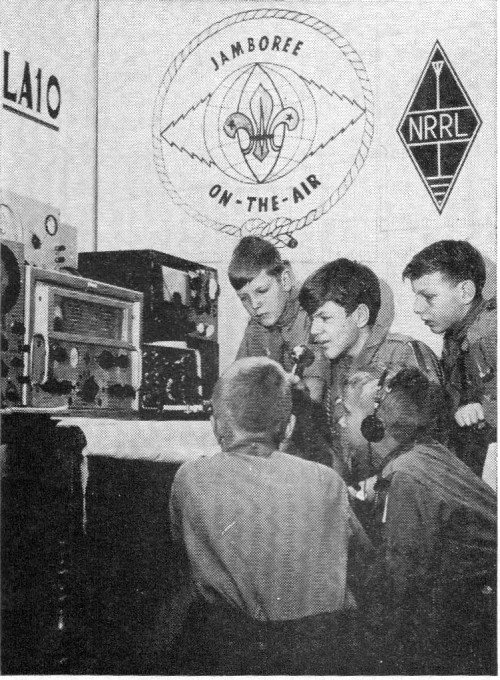
Scouts operate at LA1O, Oslo Technical School, Norway - RF Cafe
Scouts operate at LA1O, Oslo Technical School, Norway
FCC Chairman Rosel H. Hyde has recently said "Statistics seem to suggest ... some lack of interest in the amateur service by our youngsters ... (This situation) ... does require our earnest attention" (QST, April, 1967, p. 61). O.K., so we need to keep the younger fellows coming along to keep amateur radio progressing. How do we go about approaching these youngsters and whetting their interest? One of the best ready-made avenues is via the Scouting movement - with over four million active boys in the U. S. between 8 and 18. 

The radio amateur should look on Scouting as one of the several areas in which he may implement the "service" aspect of the amateur service. Certainly one of our purposes is to create enough interest on the part of boys so that some may become amateurs. However, we can't expect all boys to be equally motivated. Simply by exposing boys to amateurs and amateur operation we will be molding their image of amateurs as "cool heads" instead of "those nuts that wreck TV." And certainly the amateur has many capabilities that can be of vital aid to the Scouting program. 

Some of these areas where we've helped in the past include providing communications for various Scouting events and training boys in code and electronics. Besides expanding these services future possibilities might include help in the formation of Scouting nets to let Scouts and Scouters get to know each other better. The Jamboree-On-The-Air event is doing that already but it only happens once a year. Perhaps our goal should be Jamboree-On-The-Air year round. Let's take a look at specific aspects of possible amateur radio service to Scouting. 

Cub Scouts - These 8- to 11-year olds are full of fun and enthusiasm. They're organized into small Dens with a Den Mother; and a group of Dens makes a Pack led by a Cubmaster. Their three ranks, Wolf, Bear, and Lion, are gained by accomplishing a series of achievements and electives. Under electives are such things as "Make and use a crystal set" and "Make and operate a radio using one or more tubes." Lots of opportunity here to dig through your junk box to help a boy make a radio. A Den Mother would probably love to have you invite her Den to your shack even if they do no more than talk to another Den across town on two meters. 

Remember, though, that whether Den Mother, Scoutmaster, or Council Scout Executive you may find the person has little idea of what amateur radio may do for them. You may have to use some low pressure salesmanship with persistence. 

Boy Scouts - Boys 11 through 17 may become Boy Scouts by joining a Troop and passing the Tenderfoot tests. Patrols, run by boy leaders, comprise a troop with the adult Scoutmaster in overall charge. Advancement through set requirements gains Second Class and First Class rank while set requirements plus elective merit badges gain the Star, Life, and much coveted Eagle rank. Emphasis in the early stages is on outdoor achievements but in the higher ranks the sky's the limit! (The Space Exploration merit badge was recently introduced.) The First Class Scout, among other things, is required to "send and receive at least 20 words, using either international Morse or semaphore codes and necessary procedure signals." There are merit badges on Atomic Energy, Communications, Electricity, Electronics, Radio, and Signaling, to name those where an amateur might most likely help. Of the seven requirements for the Radio merit badge, a current amateur license is a substitute for the code requirement of 5 words a minute. Amateurs are always welcome in Troops to help boys with the First Class code requirements and to act as merit badge counselors. 

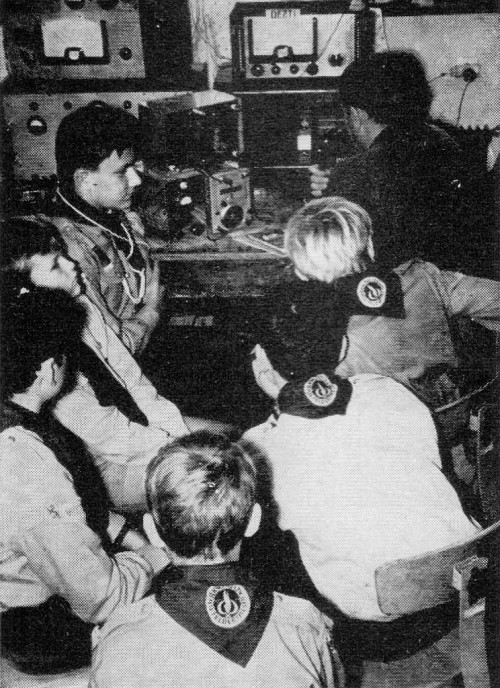
Scouts operating from the high school station near Salzburg, Austria - RF Cafe
Scouts operating from the high school station near Salzburg, Austria.
The station at Circle 13 Scout Ranch in the Kern River headquarters is the only communication for this remote California camp. Last summer it proved its worth relaying messages to anxious parents in the Los Angeles area when a bus break-down prevented several units from leaving the camp for home until a day behind schedule. Perhaps you can't take several weeks off during the summer, but how about providing your mobile or portable set-up at a Camporee or for a weekend at a Scout camp? 

Explorers - A boy going into high school and reaching age 14 may then join an Explorer Post. Emphasis in Exploring is on boy organized and conducted activities with a boy-elected President and other leaders, with adults participating as Advisors and consultants. Posts are classified as "general interest" or "special interest," with special interests ranging from aviation to zoology. The two types of Posts overlap activities in that they all attempt to provide experience for these teenagers in social, vocational, outdoor, personal fitness service and citizenship areas. Several Explorer Posts have amateur radio as a specialty and quite a few have specialties in electronics and other scientific fields. 

Post 1, King City, California, has amateur radio as a specialty and its activities may be more or less typical of a meshing of amateur and Scouting fields. Half of the members are licensed, mostly Technicians. Club station license, WB6SBL, is held and the Post owns equipment for capabilities from 80 through 2. Post members have participated in SET exercises, Jamboree-On-The-Air, a local fair, have visited Oscar headquarters and electronics manufacturers, and have used amateur gear on several activities including 55-mile backpack hikes and beach trips. Activities for the immediate future include providing communications at a District Camporee and at a Council-wide Explorer Road Rally over a hundred mile course. While amateur activities are included only insofar as members' interests dictate, all members have been exposed. 

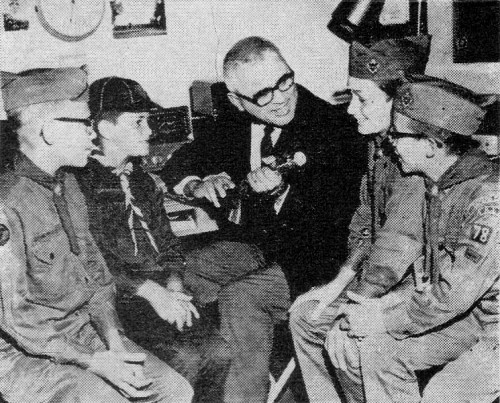
Scouts of the U.S.A., visiting the Johnston Historical Museum at the National Headquarters - RF Cafe
Scouts of the U.S.A., visiting the Johnston Historical Museum at the National Headquarters in New Brunswick, N. J., spoke to brother Scouts in 17 countries and 43 of the United States, over K2BFW, the Hq. station of the Boy's life Radio Club. Trustee of K2BFW is W2GND, shown interviewing Scouts. K2BFW had over 1500 c.w. and phone QSOs during the JOTA weekend.
Sea Exploring - This branch used to be known as "Sea Scouting" but it is now the division of Exploring that is involved in boating, seamanship, and other marine activities. Little has been done in the past by amateurs in this field, but it requires little imagination to envision the services amateur radio could perform. 

Jamboree-On-The-Air - This event was organized 10 years ago out of the thought that amateur radio might provide a vehicle for Scout to Scout communication for that vast majority of Scouts who will never have an opportunity to participate in the great National or World Jamborees. Of course, in the process it will expose many youngsters to amateur radio as an avocation and a service and to the general field of electronics. 

The Ninth Jamboree, October 22-23, 1966, was a great success in spite of its coinciding with a major DX contest. More than 3000 stations were known to have participated from 67 different countries. U. S. participation, heretofore modest, showed a fantastic tenfold jump over prior years with at least 1500 stations participating, Through the layers of QRM, U.S. stations succeeded in having many successful QSOs with other U. S. and Canadian stations and an occasional DX "catch." Participants will long remember the beautiful evening round table on the high end of 40 when Scouts from the east coast were talking with brother Scouts in Canada, the midwest, and the far west. 

1967 is the 60th anniversary of the Scouting movement and it will be commemorated as the 12th World Jamboree convenes August 1-9 at Farragut, Idaho. The World Jamboree will have its own station, K7WSJ, operative during the entire period. Jamboree-On-The-Air will be the weekend of August 5th and 6th. As before, the basic purpose of J.O.T.A. will be to provide a medium for Scouts to talk to other Scouts wherever they may be. If you're interested in serving Scouting, this event is a "must." Make your plans now to have one or more local units at your shack sometime during that period. Or arrange to take your mobile rig in to your Council's Scout Camp and string some dipoles from pine trees. 

The Boy Scouts World Bureau report on 1966 J.O.T.A. suggests that the aim of the 1967, J.O.T.A. should be "A WORLD-WIDE NETWORK OF SCOUT STATIONS IN 1967." Is this aim too ambitious for amateurs and Scouts and Scouters to accomplish? 

* Advisor, Explorer Post 1, King City, California 93930. 

пятница, 6 декабря 2013 г.

W5XJ 
Thanks for stopping by my virtual QTH on the ever useful QRZ.com!
As of 11 January 2011 my call has changed from KE5ZYP to W5XJ, read more about my new call below.
My new QSL card! I wanted a custom QSL now that I have a long-haul callsign so I called my friend Randy Dorman, KB3IFH, up in Maryland and started designing it. What we came up with was a tribute to the Republic of Texas days with several flags that flew over Texas back in 1836 - 1846 whenTexas was a country. My ancestors came to Texas in 1838 so I am a very native Texan. The flags are, clockwise from the upper left-hand corner: the 1st flag of the Republic of Texas; the Texas Navy Flag; the Gonzales Flag and the Alamo Flag. Randy was very patient with my changes and proof requests so I recommend him highly. His prices are very competitive and he offers terrific personal service. His website is http://www.kb3ifh.homestead.com and you should check it out for your next QSL order.


I'm a fairly new ham having passed my Tech in March 09, General in June 09 and on 25 March 2010 I received my Extra class upgrade. I've wanted to be a ham since I was a kid but dyslexia made it impossible for me to master the code - even 5 WPM. Boy was I thrilled to learn they dropped the code requirement. Given all that, HF phone is my preferred mode with some digital ops and AM rag chewing thrown in for good measure.
Working DX as well as monitoring local repeaters from EM12ou is big fun. I also enjoy setting up in remote locations running on battery power with my improvised vertical antennas, loops and dipoles for BSA campouts and special events throughout Texas.


Equipment & Setup:
Portable Ops: using Icom 706 MK II G, ICOM AH-4 auto-tuner, into square loops, dipoles, and an S-9 31 foot vertical powered by a deep cycle marine battery with solar panels to charge it. Also I run 160 meter square loop on ranches with mucho real estate for the big boy 160 M wire.


Fixed Ops: Ten-Tec Orion I with TT Hercules II 500 watt solid state amp, Steppir Mark II Big IR vertical with 60/80 meter coil kit, LDG AT 1000 Pro II (2012), into a110 foot multi-band dipole and resonant delta loops cut for various bands. The wire rack pictured below works great for the gear and I found it for $20 at Home Depot after looking all over the place.


DC power provided by a Walt Williams (W5YUO) 40 amp custom linear power supply. I love the old school linear supplies versus the switching type when weight is not a concern. Walt is a master power supply builder from Arlington, Texas. You may still find Walt and his famous DC power supplies at DFW area hamfests. I have recently added a commercial grade 5 amp-hour solar panel and 190amp-hour commercial UPS battery to power my amp - so far so good. Thanks to Mason for the FB battery!

Bicycle Mobile:
Lately for exercise I've started riding my hybrid bike around the lake and was using an H/T alone and it worked OK. There are some repeaters that I could not reach with that setup so I took it a step further. Below are photos of what I used out of the surplus / junk box to have a better signal while bike-mobile. This project made a huge difference in my signal and nowI can reach about every repeater that I can from my 50 watt car rig. Biking is great exercise and hamming on the road sure helps pass the time.

Wouxun H/T from www.wouxun.us mounted via a mount purchased at Ham-Com.

Close up of mount going to frame mount carrier.

Complete and ready to go, bracket is well grounded to the bike frame and tests low resistance on the meter too.
As of May 2013 I replaced the Diamond D/B antenna (above) with a homebrew vertical dipole cut for 2 meters since the SWR was quite high on the Diamond. The dipole is 1:1 SWR and more efficient and a better radiator then the Diamond given the limited groundplane a bike allows. When time permits I will post photos of the dipole. Making your own antenna is fun, rewardingand worth the effort in many cases. Try it sometime.

Boat Anchors (sometimes smelly) are great nostalgic RF fun!
Recently (May 2013) I have gotten into Boat Anchors and have picked up an AM transmitter and receiver that are older than I am. If you like the smell of old books in the library or old cars you'll love this part of the hobby. Many of these old radios came in kit form that the HAM had to assemble with a ton of soldering to be done. These bad boys used large transformers so theyweigh well over 100 pounds - not easily mobile. These need a switch to move the antenna from the receiver to the transmitter on XMIT and back to the receiver on REC. You could do this with coax switches or modern relays but there is something called a Dow Key Relay that you gotta have. The DX-100 has what is known as an octal plug in the back that has various inputs & outputs, including 110 VAC, via the DX-100 T/R switch, that powers the relay. The radio has a built in antenna matching system that tunes up like atube type amp does such as the AL-811, etc. Clearly this takes far more effort that my Ten-Tec does but it is fun to see this early ham radio in operation. If you get bored with modern gear give this a try just be careful to not let the "magic smoke" escape from the unit. I've found that once the magic smoke gets out you cannot put it back in without a lot of difficulty. There is a great boat anchor net on Saturday mornings at 7:00 AM Texas time on 3.890 AM so come join us whether you have an old or new radio - nobody cares as long as you can get a decent signal out there.AM ops can also be heard on 3.880, 7.160, 14.286 & 330, and 29.000 - 29.100. The best time for AM is late at night or early in the morning, once the sun gets up it gets noisy so get up early, brew a pot of joe, grab the paper, fire up your rig, kick back, and give 3.890 a listen.
Dateline 23 August 2013: thanks to WW9W I added a DX-40 AM transmitter and VF-1 VFO to the meager collection. It is much easier to work on than the crowded DX-100. Tomorrow will be its debut on the 3.890 AM net so I hope they will hear me using the Steppir BigIr vertical.
Heathkit DX-40 AM/CW Transmitter and VF-1 VFO circa 1959

Heathkit DX-100 AM/CW transmitter circa 1958

National NC-300 AM/SSB/CW Receiver circa 1959

These things use something called "vacuum tubes" that glow when operating which is interesting and they keep the shack warm in the winter.
This photo is the 6146 tubemade by GE and the DX-100 uses them in the final amplifier stage,two of them in the DX-100. The DX-100 only likes 6146's of 6146A's, not B's or other variants of the B type tube or else you'll find out what VHF/UHF parasitic radiation is. Also B type tubes are difficult to neutralize which you need to do with the DX-100 transmitters.

My Vanity Call:
I'm very pleased to have shed my 2X3 call on 11 January 2011 in favor of the new 1X2 and wish to thank Fred, with W5YI (SK), for his help finding me the new one. Fred did a great job and most of all delivered on his promise to do his best to secure the call for me. RIP Fred.
The previous holder of W5XJ was a well known West Texas Ham named David Smith (SK) from Winters, Runnels County, Texas. I never had the pleasure of a QSO with David as he became a SK beforeI received my first license. I am very familiar with Winters, Runnels County, and the near West Texas area since I have visited there often. One of my best friends and native son of Winters owns the Dry Hollow Ranch outside of town. I'm very pleased to keep the call in Texas and 5-land where it belongs.
Prior to David, my call was held by Terry Burkholder, now N4TB, when he was living in Texas. Terry told me the call was pretty good for CW. A lot of hams in the Dallas area remember Terry.

DX and not so DX Trips:
From 12/27/09 - 1/2/10 I was setup portable in vacation rental on the side of a hill in the southeast part of Santa Fe, NM running the 706 MK II G and a new multi-band dipole that was far too low to the ground. Made some good contacts nonetheless! Next time I am bringing the monster delta loop for 160, ladder line,anda balanced linetuner.
December 2011 - January 2012 I was back in Santa Fe running portable and on the Santa Fe area repeaters. Thanks to all the SF area hams for the warm welcome, again.
In May 2012 I was QRV on top of the Texas Monument outside Houston running simplex FM on 146.52 and made many contacts with the coastal bend area hams.
July 9th - 23rd 2012 we were QRV driving 4,000 miles from Dallas to visit friends in Big Sky, Montana and back via: Philmont Scout Ranch / Cimarron, NM; YMCA of the Rockies / Estes Park, CO; a stop at W W V in Fort Collins, CO; Grand Teton National Park in Wyoming; Yellowstone National Park in Wyoming; Tatom Homeplace / Big Sky, Montana; Mount Rushmore in Keystone, SD and home through Nebraska, Kansas, Oklahoma and back to Texas. I was running mobile on 20 & 40 and some 6 Meter mobile as well. Good to hear everyone on the 7.185 net along the way and for the many FB QSO's.

Elmer Credits:
Many thanks to all the hams that have helped me get started in this great hobby: KC5AKB had great ideas and encouragement plus my first QSL card in the mail; W5SYU helped test my first HF rig (a used 706 MKIIG off craig's list);WY5V for his extraordinary help with my RFI & antenna issues;K5XG & AK5DX fortheir QRO, antenna and tower expertise; andRuss, K5OSH, for hisboat anchor library. HAMSthat take the time to help new hams are the best! Help a new ham get started today,you will feel good doing it while helping launch another into this great hobby.

Circle Ten Radio Scouting:
Recently we launched the webpage to promote HAM radio to the Scouting community in North Texas. If you are interested in joining the group visit our page to learn more about our programs by clicking this link

Don't miss the BSA Jamboree on the air (JOTA) each October 20th. Talk to scouts and show them what radio is all about.Get your club to bring HAM radio to a scout unit and let them help you setup the station and operate. Field day is also a great time to work with scouts.
For more info on JOTA visit www.scouting.org/jota and to register your JOTA station and www.k2bsa.org

Videos / W5XJ Youtube Channel:
Sometimes a picture is worth 1,000 words so I post various "how to" and "I did" ham related videos to You Tube, if you want to see them, here they arehttp://www.youtube.com/user/W5XJ and thanks to my son Mitchell for the FB camera work - hopefully he'll have his Tech license soon.

Hope to hear you on the bands whenever I take a break from leasing and selling office and warehouse space in EM12!

73 and good DX de W 5 X J
JOTA 2013
http://www.qrz.com/db/?callsign=GB0NFB
We are the 91st Bristol Scout Group and this was our special-event station for Jamboree On The Air 2013.
JOTA runs over the weekend of 19th-20th October and gives Scouts and Guides all over the world the opportunity to contact each other and other amateur radio operators and pass greetings messages. More information about JOTA can be found athttp://www.jotajoti.org/.
91st Bristol is based in the city of Bristol in the south-west of England. Our web site can be found here and you can follow us on Twitter as @91stBristol.
We will be operating on or around the usual Scout frequencies on 40m, 20m and 10m. The planned schedule of operation is as follows:
Friday 18th (am)Setting up station
Friday 18th (pm)Station on air (testing)
Saturday 19th (am)Station on-air
Saturday 19th (pm)Station on-air
Sunday 20th (am)No operation
Sunday 20th (pm)Station on-air
The station is managed and operated by G7AGI. Please QSL via the bureau to GB0NFB or direct via G7AGI, NOT to the address above which is the station address. We will QSL 100% and there is no need to include return postage; you send us yours and we will send you ours.
Thank you to Simon at Radiozing and Nigel at M0CVO Antennas for sponsoring us with equipment we needed. We could not have done this without their kind and generous support.


================================================
http://www.qrz.com/db/?callsign=GB1RES

GB1RES - Rotherham Explorer Scouts

This is the Call Sign for Rotherham Explorer Scouts Special Event Stations.
QSL Cards very welcome, via the Bureau / eSQL.cc / Direct

GB1TE 
We are the Trent explorers and 107th Weston Aston and Shardlow Scout group operating a JOTA station from Drum Hill Camp site Derby over the weekend of 19/20 October 2013. We hope to make some great scouting contacts around the world over the weekend 73s.
DL0JAM 
Lars Weimar, DG4SEV
Wetterkreuz 12
89155 Erbach-Ersingen
GERMANY
Click to shrink...